The Gallup International Association End-of-Year (EOY) Survey 2025, the world’s longest-running global public opinion study, has released new findings, covering public opinion in 59 countries on population growth and 61 countries on the ideal number of children. The results reveal a sharply divided world: aging societies fear population decline yet increasingly prefer smaller — and in some cases child-free — families, while faster-growing societies worry about rapid expansion but continue to idealize larger households.
Conducted annually since 1977, the End-of-Year Survey is carried out by the Gallup Interna-tional Association (GIA), a worldwide network of independent and professional polling organiza-tions. Founded in 1947 by Dr. George Gallup, the pioneer of modern scientific public opinion research, the Association continues to provide one of the most authoritative and synchronized snapshots of global public sentiment.
Global Opinion on Population Growth
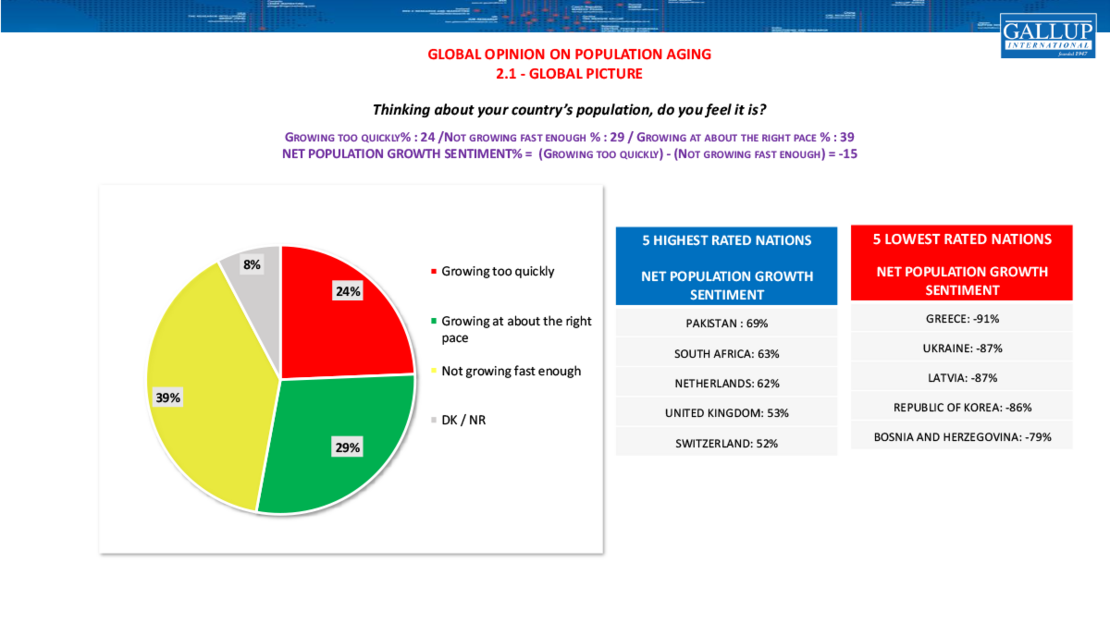
Across 59 countries (N = 58,302), global opinion leans slightly toward concern about insufficient population growth. Twenty-four percent say their country’s population is growing too quickly, 39 % say it is not growing fast enough, and 29 % say it is growing at about the right pace. The global net population sentiment stands at -15, meaning more people believe their population is not growing fast enough than too quickly.
Countries most concerned about rapid growth include Pakistan at +69, South Africa at +63, the Netherlands at +62, the United Kingdom at +53, and Switzerland at +52.
Countries most concerned about population decline include Greece at -91, Ukraine at -87, Latvia at -87, the Republic of Korea at -86, and Bosnia & Herzegovina at -79.
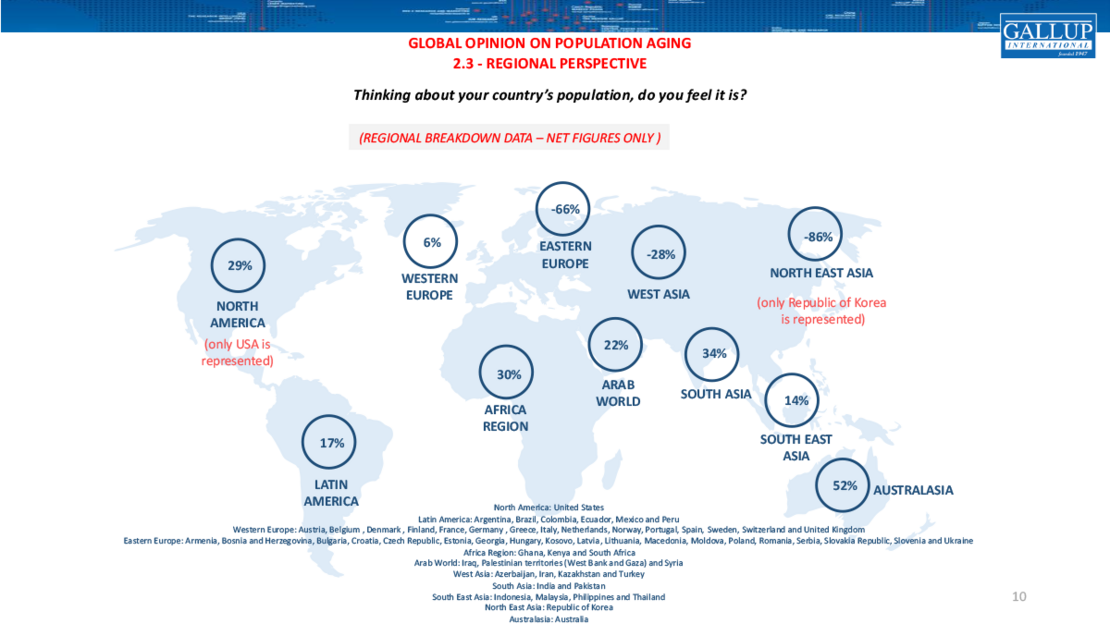
Regional patterns show Eastern Europe (-66) and Northeast Asia (-86) expressing the deepest concern about shrinking populations. Africa (+30) and South Asia (+34) are more likely to feel population growth is too fast. Western Europe (+6) reflects mild concern about growth, while Australasia (+52) shows the strongest feeling that their population is growing too quickly.
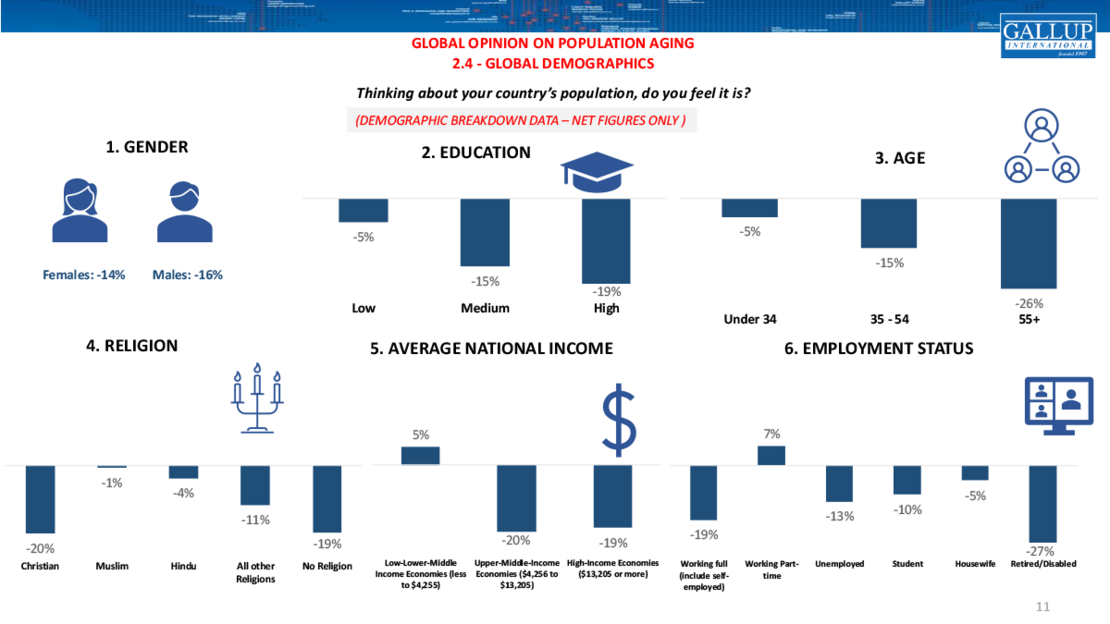
Older respondents (55+) are more likely to perceive insufficient growth, while lower-income economies tend to report greater concern about rapid expansion.
Global Opinion on Ideal Number of Children
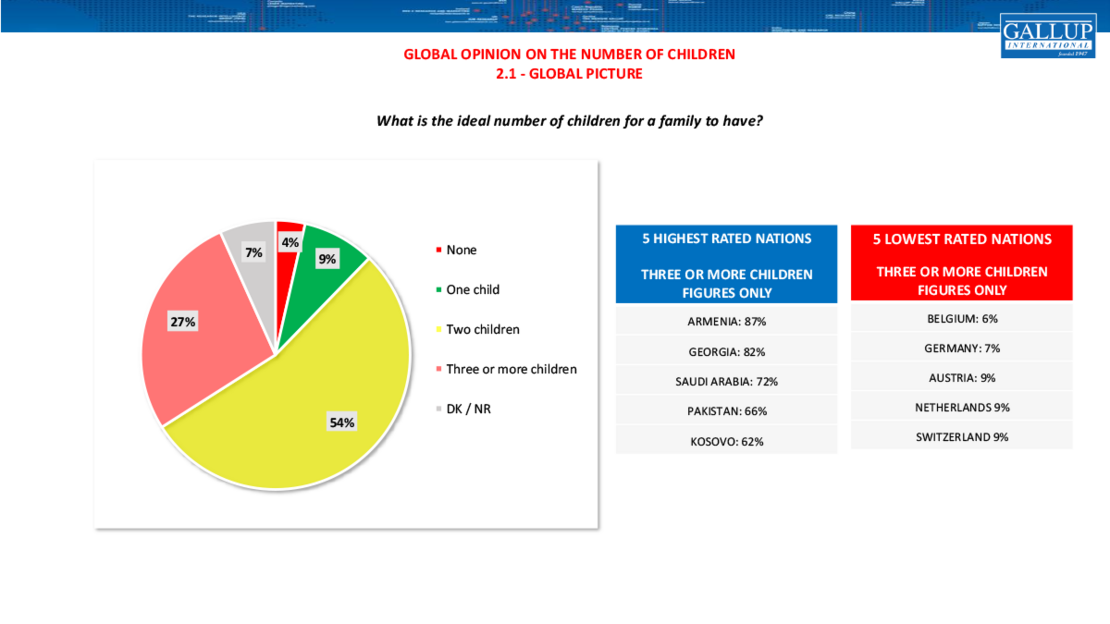
Across 61 countries (N = 60,474), the dominant global norm remains the two-child family. Fifty-four percent say two children is ideal, 27 % prefer three or more children, 9 % prefer one child, and 4 % say no children is ideal.
While the two-child model remains central globally, a measurable and growing minority now openly prefers a child-free ideal.
The Rise of the Child-Free Preference
Globally, 4 % now say the ideal family size is no children. While still small, this figure reaches double digits in some countries and has increased substantially over time.
Brazil records 14 % saying no children is ideal, followed by the United States at 10 %, Belgium at 9 %, Austria at 5 %, and Germany at 5 %.
At the other end, Armenia, Georgia, and Macedonia record 0 %. The Philippines and Pakistan each record 1 %.
How the Child-Free Ideal Has Changed Since 1980
Among countries with historical comparison data, Brazil has increased from 3 % in 1980 to 14 % in 2025, a rise of 11 percentage points. The United States has increased from 3 % to 10 %, a rise of 7 points. Austria has risen from 1 % to 5 %, Germany from 2 % to 5 %, and Australia from 2 % to 5 %. Sweden remains stable at 1 % in both 1980 and 2025.
The increase is particularly notable in Brazil and the United States, suggesting growing social acceptance of voluntary child-free lifestyles in parts of the Americas and Europe.
Income Divide in Family Ideals
A clear economic gradient emerges. In high-income economies, more than 60 % prefer two chil-dren and very few favor three or more. In lower-income economies, preference for three or more children remains substantially higher. South Asia records only 30 % selecting two children, re-flecting higher tolerance for larger families. Western Europe records 63 % selecting two chil-dren, reinforcing the small-family norm.
The Global Demographic Paradox
Taken together, the two questions reveal a striking contradiction. Many aging societies fear population decline, yet within those same societies, smaller families — and even child-free ideals — are becoming more accepted. Meanwhile, faster-growing societies often idealize larg-er families even while expressing concern about rapid growth.
This tension between demographic anxiety and demographic aspiration could shape debates on migration policy, pension sustainability, long term healthcare, youth employment, gender roles and work-life balance, as well as urbanization and housing markets.
Sample Size and Mode of Fieldwork:
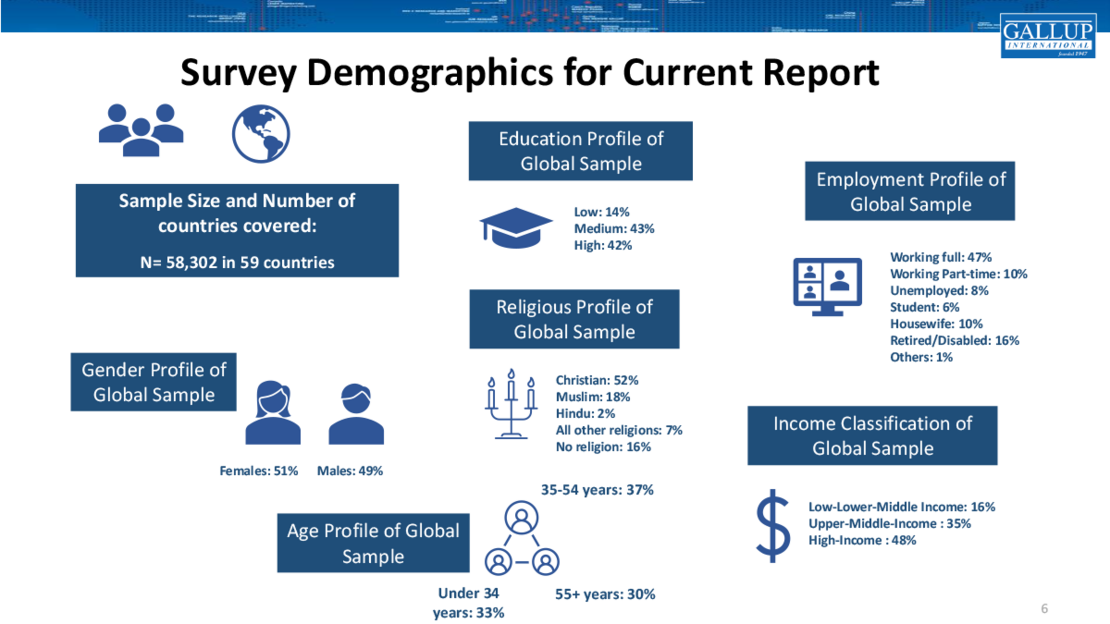
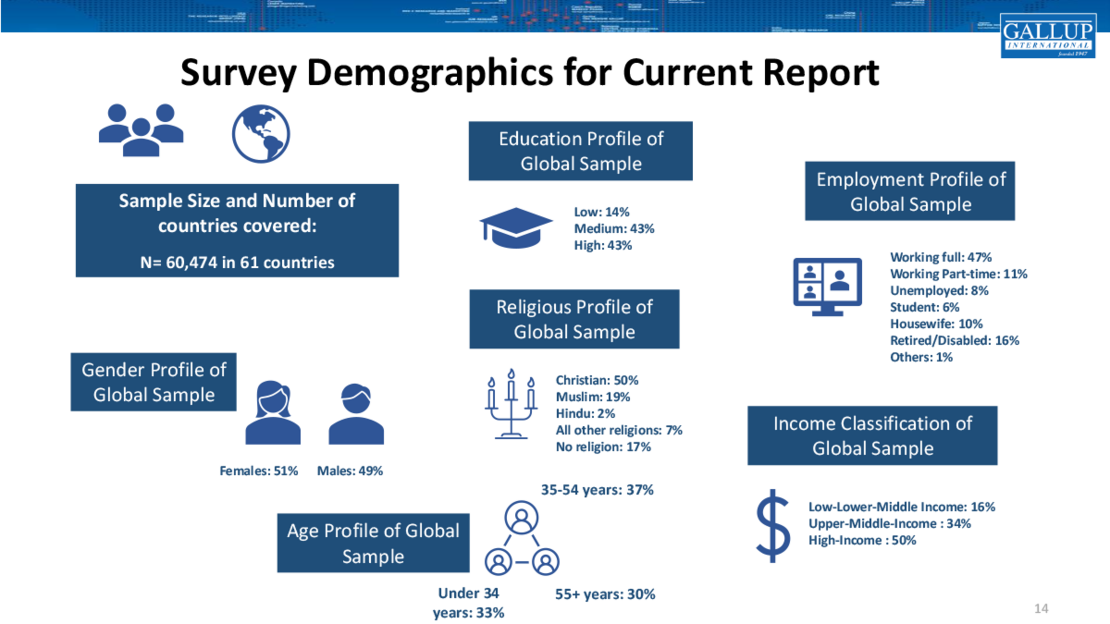
The survey interviewed 61 countries (N = 60,474) on question of ideal size of family and 59 coun-tries (N = 58,302) on question of population growth. In each country, typically around 1,000 re-spondents were interviewed between October and December 2025.
Of the countries surveyed, 56 employed a national sample, while 4 interviewed urban only populations. In terms of sample size, 9 countries had a sample size of under 1000, 15 countries had a sample size of 1000, and 36 countries had a sample size exceeding 1000. As for survey modes, 10 countries used CATI (Computer-Assisted Telephone Interviewing), 37 countries used CAWI (Computer-Assisted Web Interviewing), and 13 countries employed face-to-face inter-views. In terms of sampling methods, 2 countries utilized a non-probability sample, 33 countries used quota sampling, and 26 countries applied random probability sampling.
About Gallup International Association
Gallup International Association (GIA) is the world’s leading global independent association in market research and public opinion polling.
For more than 75 years, Gallup International members have demonstrated their expertise in conducting multi-country surveys on a fully comparable basis, consistently delivering research of the highest methodological quality. Today, the Association brings together over 65 members who together with partners have the capacity to cover more than 130 countries of the world with opinion polling. Each member is a leading national research institute with deep local ex-pertise in research methods, statistical systems, culture, and social context.
With a strict one-member-per-country policy, Gallup International ensures independence, credibility, and the highest professional standards. Member agencies collaborate closely on a daily basis, sharing knowledge, innovative research techniques, and tools, while jointly deliver-ing robust, reliable, and culturally informed insights for international research projects.
Gallup International was founded in 1947 by George Gallup, the pioneer of modern scientific public opinion research together with colleagues from 10 countries.