The Gallup International Association End-of-Year (EOY) Survey 2025, the world’s longest-running global public opinion study, reveals a clear and consistent global pattern in attitudes toward migration: Europe has markedly different attitudes towards immigration than most other re-gions of the world while opinions towards emigration are more diverse.
While migration remains one of the most politically charged issues worldwide, public opinion across continents shows a striking contrast—high-income countries are increasingly resistant to mobility in both directions, while poorer countries remain broadly supportive of cross-border movement.
Conducted annually since 1977, the End-of-Year Survey is carried out by the Gallup Interna-tional Association (GIA), a worldwide network of independent and professional polling organiza-tions. Founded in 1947 by George Gallup, the pioneer of modern scientific public opinion re-search, the Association continues to provide one of the most authoritative and synchronized snapshots of global public sentiment.
The 2025 End-of-Year Survey asked respondents in 60 countries whether people leaving their country to migrate abroad and people coming from other countries greatly benefits, somewhat benefits, somewhat hurts, or greatly hurts their country.
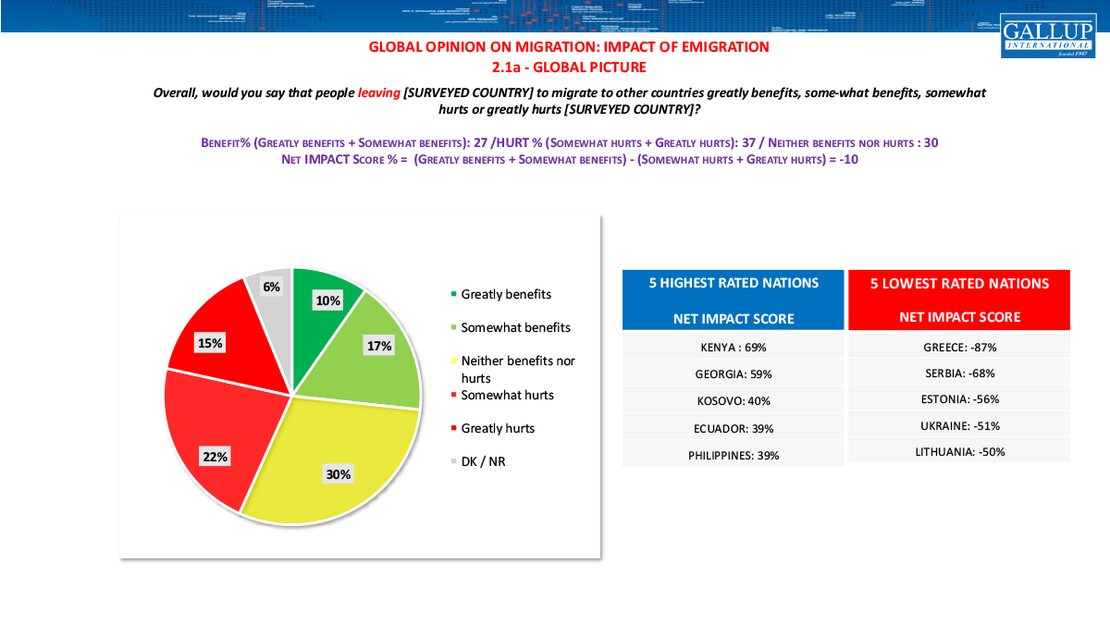
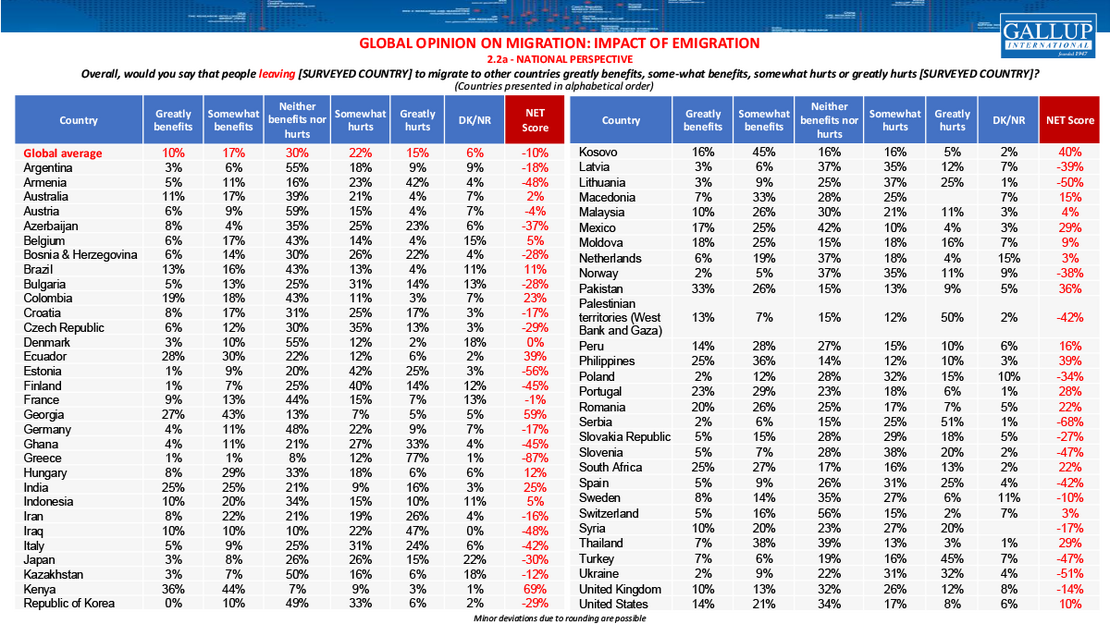
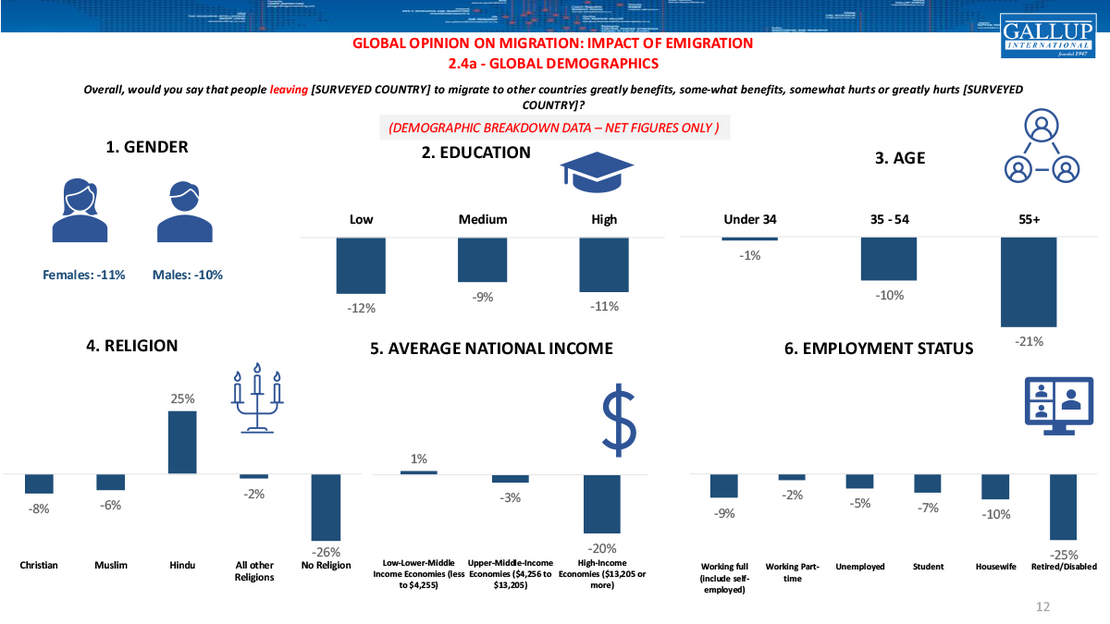
At the global level, emigration is viewed more negatively than positively. Just over one in four (27 %) respondents worldwide believe that people leaving their country benefits it, compared with 37 % who believe it hurts, producing a global net score of –10. Three countries who have re-cently experienced significant emigration caused by conflict stand out; on the one hand there is the so called ‘brain drain’ while on the other there is a hope of a more peaceful/prosperous life. Yet 63 % of Ukrainians agree that emigration has hurt their country, just 11 % saying there has been a benefit. The picture in Iraq is similar – 69 % argue that mass emigration has hurt their country, while in Syria 47 % claim it has hurt their country.
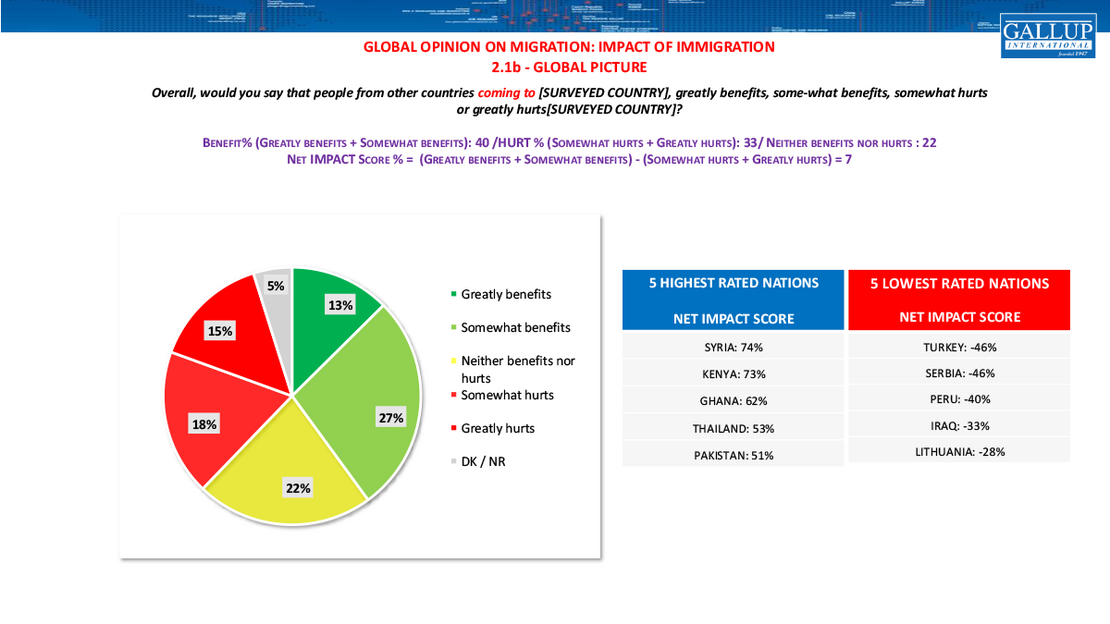
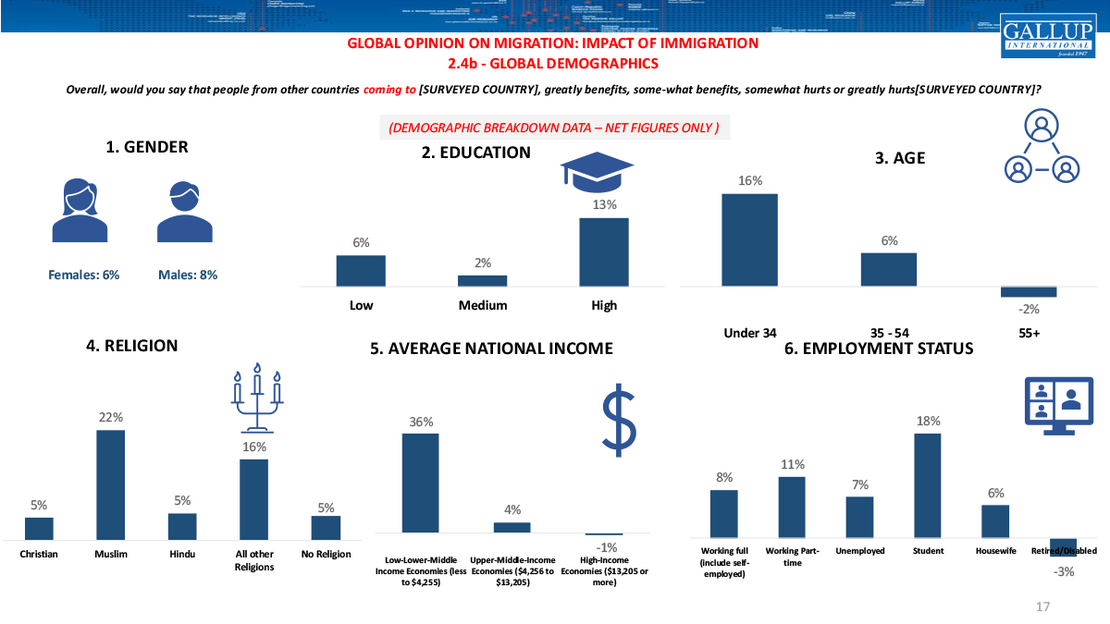
Immigration, by contrast, is generally viewed more favorably. Globally, 40 % believe immigration benefits their country, while 33 % believe it hurts, resulting in a positive global net score of +7.
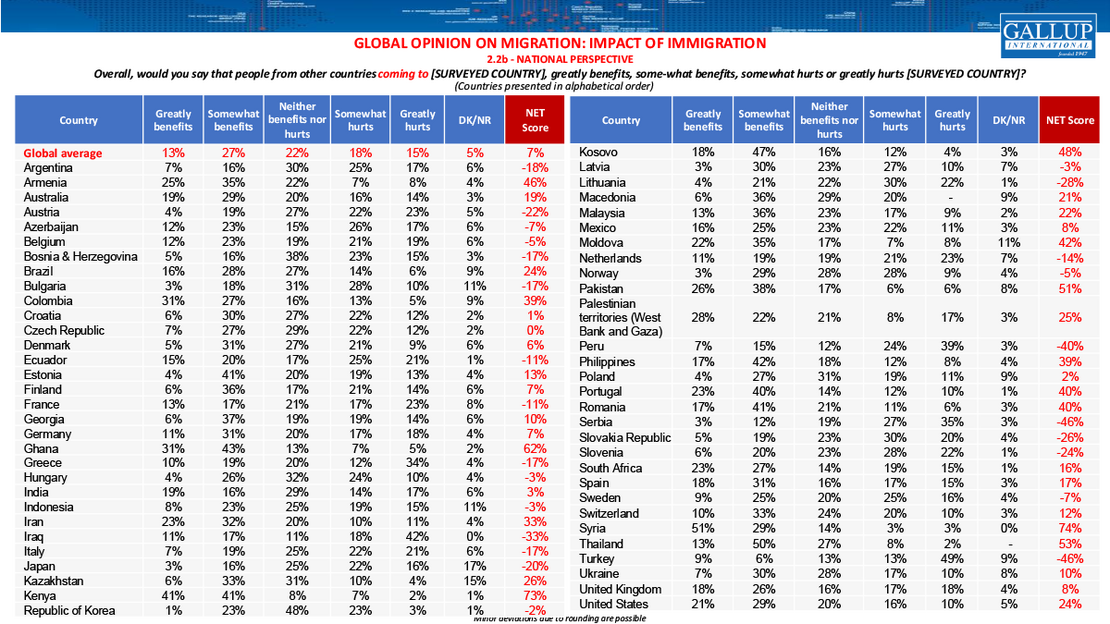
Country-level results show a clear global asymmetry: 34 out of 60 countries believe emigration harms their country more than it helps, while 34 out of 60 countries see immigration as a net benefit—highlighting a widespread preference for receiving migrants rather than losing citizens.
Opposition to migration is most intense in a small group of countries. On immigration, the strongest net opposition is recorded in Serbia (–46 %), Turkey (–46 %), Peru (–40 %) and Iraq (–33 %). Resistance to emigration is even sharper: Greece records the most negative net score globally (–87 %), followed by Serbia (–68 %), Estonia (-56 %), Ukraine (–51 %), Lithuania (–50 %) and Armenia (–48 %).
Positive views of migration are concentrated in a smaller set of countries. On immigration, the strongest net support is seen in Kenya (+73 %), Syria (+74 %), Ghana (+62 %), Thailand (+53 %) and Pakistan (+51 %). Support for emigration is led by Kenya (+69 %), Georgia (+59 %), Kosovo (+40 %), the Philippines (+39 %) and Ecuador (+39 %).
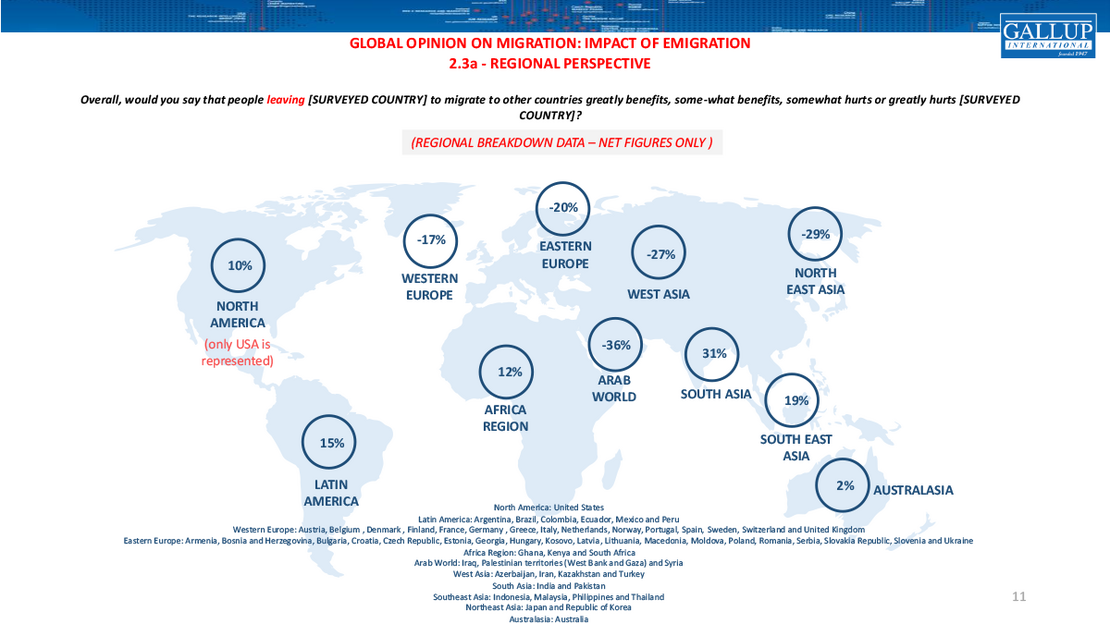
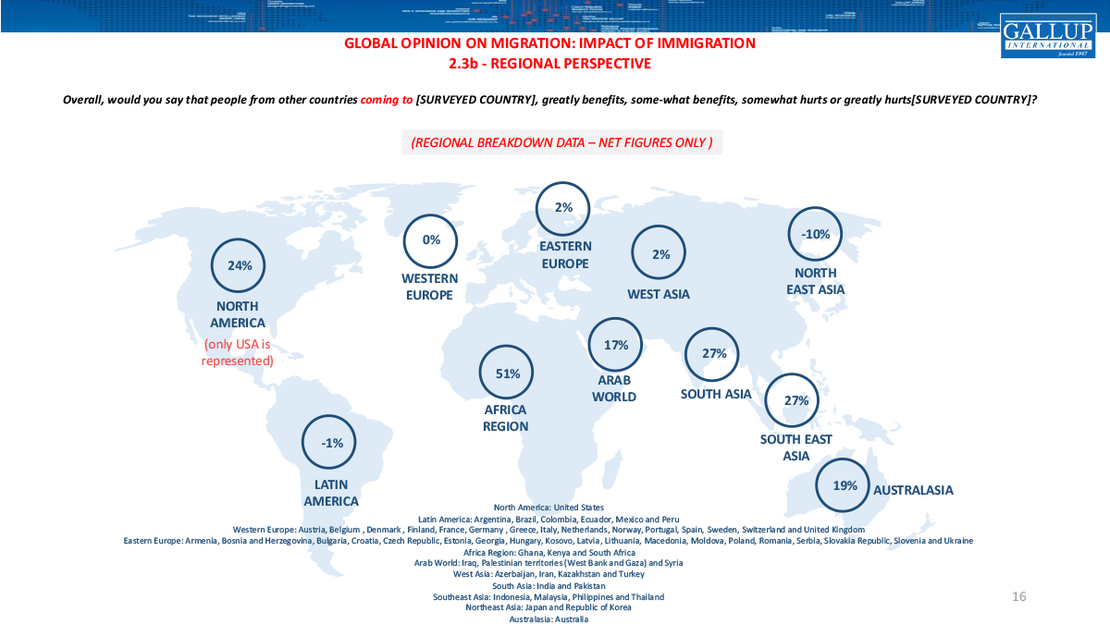
Europe and Japan/Korea (North East Asia) stand out globally for their particularly strong con-cern over emigration and their continued ambivalence toward immigration. The survey shows that North East Asia (-29 % net score) and Europe are among the most likely worldwide to view people leaving their country as harmful, with net impact scores of –17 in Western Europe and –20 in Eastern Europe. These attitudes reflect widespread anxiety about the brain drain, ageing populations, and long-term economic competitiveness. Yet on attitudes towards people arriv-ing in their countries both North East Asians and Europeans remain very divided – a net impact score of -10 % in North East Asia, +2 % in Eastern Europe and 0 % net score in Western Europe. This contrasts for example with Africa +51 %, South Asia +27 %, Australia +19 % and the Arab world +17 %.
Michael Nitsche, President of Gallup International Association:
“Attitudes toward mobility are closely linked to how societies perceive their own social and economic development. In countries with stronger prospects for growth and advancement, mi-gration is more often seen as a gain, whereas in societies where economic or demographic pressures are increasing, it is more frequently perceived as a threat. Migration has therefore become more than a political issue — it reflects broader questions of competitiveness, social cohesion, and future security.”
Sample Size and Mode of Fieldwork
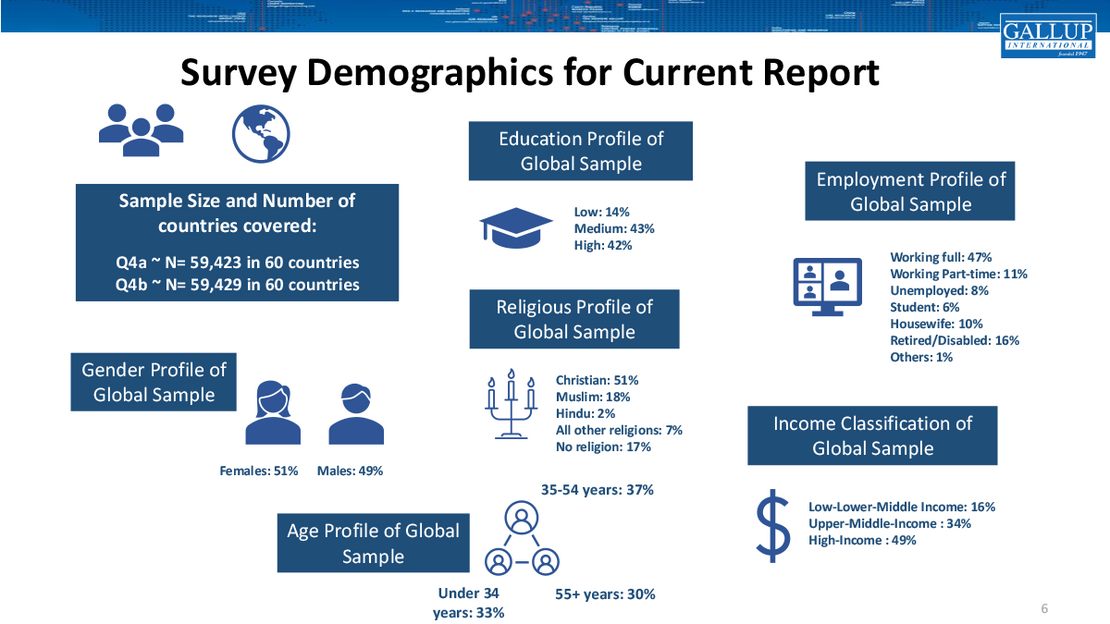
This press release is based on data from 60 countries in the Gallup International End-of-Year Survey 2025, with 59,423 respondents for Q4a and 59,429 respondents for Q4b. In each country, typically around 1,000 respondents were interviewed between October and December 2025.
Of the 60 countries surveyed, 56 employed a national sample, while 4 interviewed urban only populations. In terms of sample size, 9 countries had a sample size of under 1000, 15 countries had a sample size of 1000, and 36 countries had a sample size exceeding 1000. As for survey modes, 10 countries used CATI (Computer-Assisted Telephone Interviewing), 37 countries used CAWI (Computer-Assisted Web Interviewing), and 13 countries employed face-to-face inter-views. In terms of sampling methods, 2 countries utilized a non-probability sample, 33 countries used quota sampling, and 26 countries applied random probability sampling.
About Gallup International Association
Gallup International Association (GIA) is the world’s leading global independent association in market research and public opinion polling.
For more than 75 years, Gallup International members have demonstrated their expertise in conducting multi-country surveys on a fully comparable basis, consistently delivering research of the highest methodological quality. Today, the Association brings together over 65 members who together with partners have the capacity to cover more than 130 countries of the world with opinion polling. Each member is a leading national research institute with deep local ex-pertise in research methods, statistical systems, culture, and social context.
With a strict one-member-per-country policy, Gallup International ensures independence, credibility, and the highest professional standards. Member agencies collaborate closely on a daily basis, sharing knowledge, innovative research techniques, and tools, while jointly deliver-ing robust, reliable, and culturally informed insights for international research projects.
Gallup International was founded in 1947 by George Gallup, the pioneer of modern scientific public opinion research together with colleagues from 10 countries.